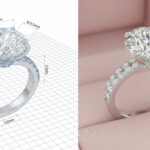
Scroll through any premium brand website today, and you’ll notice something instantly: the visuals don’t just look good, they feel intentional. Products are polished before they exist. Jewelry sparkles in impossible lighting. Architectural spaces are lived in before a single brick is laid.
That’s not luck. That is 3D modelling and rendering in tandem.
Here’s something that helps break it down:
Industry studies show that interactive and 3D-based visuals can drive over 90% more user engagement than static images, making them the biggest force behind digital marketing and e-commerce.
But even though people often use the terms 3D modelling and rendering interchangeably, they are in fact very different operations, each with its own role, mindset and creative impact. Recognizance that difference helps brands make smarter choices and land visuals that do the job.
Now let’s unpack it in a way that actually adds up.
What Is 3D Modeling?
It all starts with 3D modelling. It’s the act of creating a digital object from scratch, using specialized software to convey its form, structure and dimensions.

Building the Digital Foundation
Think of a 3D model as a virtual blueprint. Artists build each curve, edge and surface so that the object can be presented properly in a digital environment. Be it a piece of jewellery, a prototype product or a building, the model has to be technically sound before anything else comes into play.
Precision Over Aesthetics (At First)
Beauty takes a backseat to accuracy at the modelling phase. Proportion, scale and structure are the names of the game. And if a ring band is too thick, or a gemstone setting is off by a millimetre, it skews everything else that comes next, realism, credibility.
A Reusable Digital Asset
A 3D model is an asset that lasts for many years to come. It can be utilised with more than one render, animation time, design variation, or even manufacturing. This flexibility is one of the best reasons to invest in quality for your models early in the game.
What Is Rendering?
If modelling is the building, rendering is when the emotion enters the space. Rendering makes a machine model feel like a photograph of something convincing, seductive, and authentic.
Turning Data Into Visual Reality
Rendering is determining how light interacts with surfaces, how reflections take place, and what materials do under different circumstances. It’s also what makes gold warm, diamonds sparkle, and matte finishes feel soft.”
Lighting, Mood, and Storytelling
A render is about more than just accuracy,y it’s about emotion. Soft shadows can give a product that luxurious look and feel. High-contrast lighting can add drama. Camera angles can accentuate the craft or function of a pedal. All this influences how viewers react emotionally.
Replacing Traditional Photography
One of the great virtues of rendering is control. You don’t have to worry about location, physical samples or perfect weather. Literally everything is adjustable from light intensity to background hue, so brands can make visuals that are consistently, scalably brand-aligned.
Side-by-Side: 3D Modelling vs. Rendering
To really clarify the difference, let’s look at both processes next to each other.
| Aspect | 3D Modeling | Rendering |
| Primary Purpose | Creates the object’s structure and form | Creates the final visual appearance |
| Main Focus | Geometry, proportions, accuracy | Lighting, textures, realism, and mood |
| Output | A digital 3D asset | Images, animations, or interactive visuals |
| Skillset Required | Technical precision and spatial thinking | Artistic vision and visual storytelling |
| Role in Workflow | First and foundational step | Final step that brings everything together |
The two processes reinforce each other. No matter how stunning a render looks, it won’t save a bad model, and the most perfectly lit/shaded model will not blow anyone away without thoughtful rendering.
The Creative & Technical Differences
Despite being part of the same pipeline, modelling and rendering demand entirely different types of thinking.
Creative Differences
- 3D modelling is organised and architectural. Artists think like engineers, analysing how forms relate to and work together. Here, creativity plays subtly; it resides within problem-solving and clean execution.
- Rendering is expressive and emotional. Artists think like photographers and directors, composing light and composition to direct the eye of the viewer and their mood.
Technical Differences
- Modelling concerns with topology, dimensions and fidelity. Mistakes made at this level can lead to visually-related issues further down the road.
- Rendering delves into physics-based simulations, reflections, refractions, and casting of shadows, and how materials respond to light.
Together, they marry left-brain rigour with right-brain art.
How These Processes Work Together
There are no stand-alone great visuals. They have a very clear and collaborative workflow:
Process: Concept → 3D Model → Rendering → Block Stack Image
- Idea & Concept
It always starts with a vision, drawings, inspirational images or design intentions. This applies to its final visual communication, not just how it should look.
- 3D Modeling
The idea is converted to a detailed digital format. Each layer we build needs careful consideration for realism, scalability and flexibility as it factors into the decisions further in the process.
- Rendering
The model is thrown into a visual context. The lighting, textures and angles are perfected until the image looks authentic, quality and in line with your brand.
- Final Visual Output
Use the finished render anywhere on the web, in ads and catalogues, or on social media for easier design continuity from concept to realisation.
This is why you need both modelling and rendering to create professional visualisation at its best.
Why You Need Both for High-Quality Visualisation
Cutting corners or under-investing in either step would show, even if it’s unclear to viewers exactly why something feels “off.”
- Modelling Ensures Credibility
Accurate models build trust. Buyers can subconsciously feel when proportions, details or materials are off.
- Rendering Drives Desire
Rendering adds emotion. It turns narrative into attraction and curiosity into intent.
- Together, They Create Impact
When both are executed well, visuals don’t just explain a product,t they sell one. They waive off apprehension, instil assurance and improve brand image overnight.
FAQs
1. What is the main difference between 3D modeling and rendering?
3D modelling is the creation of the digital object, whereas rendering transforms that model into realistic images using lights and textures.
2. Do I need both 3D modeling and rendering for my project?
Yes. Modeling adds structure and truth, while rendering imparts realism and emotion. Without one, the other restricts how good an image you can see.
3. Which is more important: 3D modeling or 3D rendering?
Neither works well alone. For good final visual quality, the balance between detailed datamodelling and readable visualization is a key point.
4. How long does 3D modeling and rendering take?
Timeframes can differ depending on complexity and quality requirements. Some can be a few days as simple projects, while more complex visuals I have taken upto 2 weeks refining.